Landscapes of the Soul: Identity and Place in Zurich
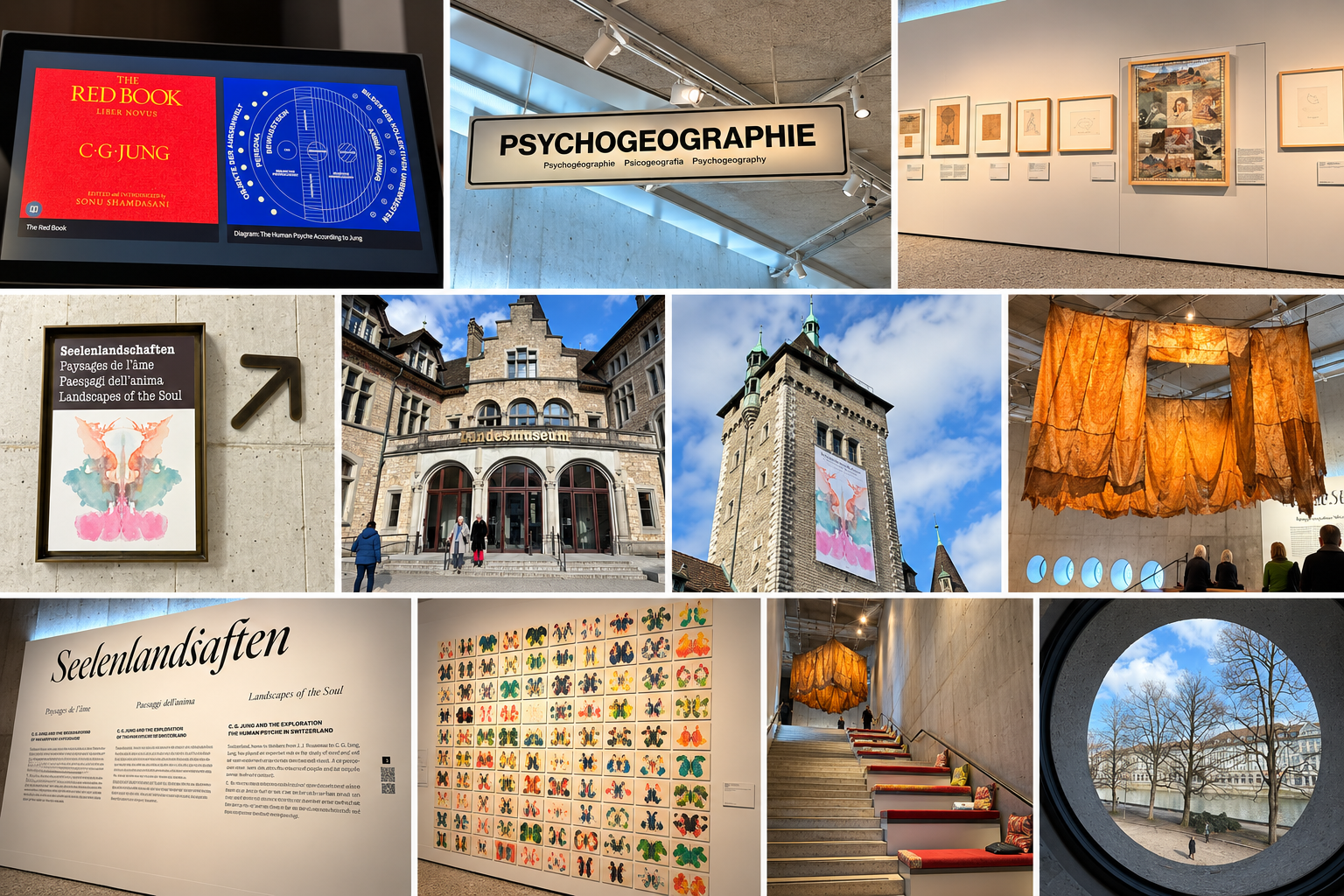
I went to see Seelenlandschaften — Landscapes of the Soul — at the Landesmuseum in Zurich because the title immediately called me.
(Link: https://www.landesmuseum.ch/seelenlandschaften)
There was something about those two words together — soul and landscape — that made me think about the relationship between our identity and the places we inhabit. We usually imagine a landscape as something outside us: mountains, cities, houses, streets, languages and cultures, the physical and social environments through which we move. And yet, how separate are they really from what happens inside us?
We perceive the world through who we are, through our memories, experiences, expectations and associations, but the opposite happens too: the places we inhabit shape us in return. Perhaps this question feels particularly close to me because I have spent so much of my life moving between countries and cultures, and I have come to feel that a place is never simply a backdrop. Over time, it enters our habits and relationships, our language and ways of seeing things, sometimes even our understanding of who we are.
I had been procrastinating my visit to the exhibition for months, so I was lucky to make it just before it closed — and very glad that I did.
SWITZERLAND AS A LANDSCAPE OF THE PSYCHE
I had expected an exhibition about C. G. Jung. What I found was considerably broader.
Seelenlandschaften was created for the 150th anniversary of Jung's birth, yet rather than presenting him in isolation, it placed his work within a much larger Swiss history of attempts to understand the human psyche: from Rousseau and Nietzsche to Hermann Rorschach and Ludwig Binswanger, and through psychoanalysis, psychiatry and art to contemporary questions around identity and mental health.
One expression in particular stayed with me:
PSYCHOGEOGRAPHY
The exhibition described psychogeography as an exploration of how landscapes and architecture can affect the psyche, asking, for example, where the “psychogeographical hubs” of our cities might be and how the landscapes of Switzerland have influenced artists, thinkers and patients.
The idea immediately made me think beyond geography itself and about the places that have shaped us: the city in which we became independent, the house where we felt safe — or didn't — the country in which we first experienced being foreign, or the landscape that somehow feels like home despite not being where we were born.
Psychogeography belongs to a particular artistic and intellectual tradition rather than being a clinical psychological theory, but the broader question it raises — whether our surroundings matter psychologically — is still very much alive. Contemporary research across environmental psychology, public health and urban studies continues to investigate relationships between our natural, built and social environments and psychological wellbeing.
So perhaps landscapes are never entirely external: we live in them, but to some extent they also live in us.
BEYOND THE “BODY–SOUL MACHINE”
From there, the exhibition took me much further back in the history of our attempts to understand ourselves.
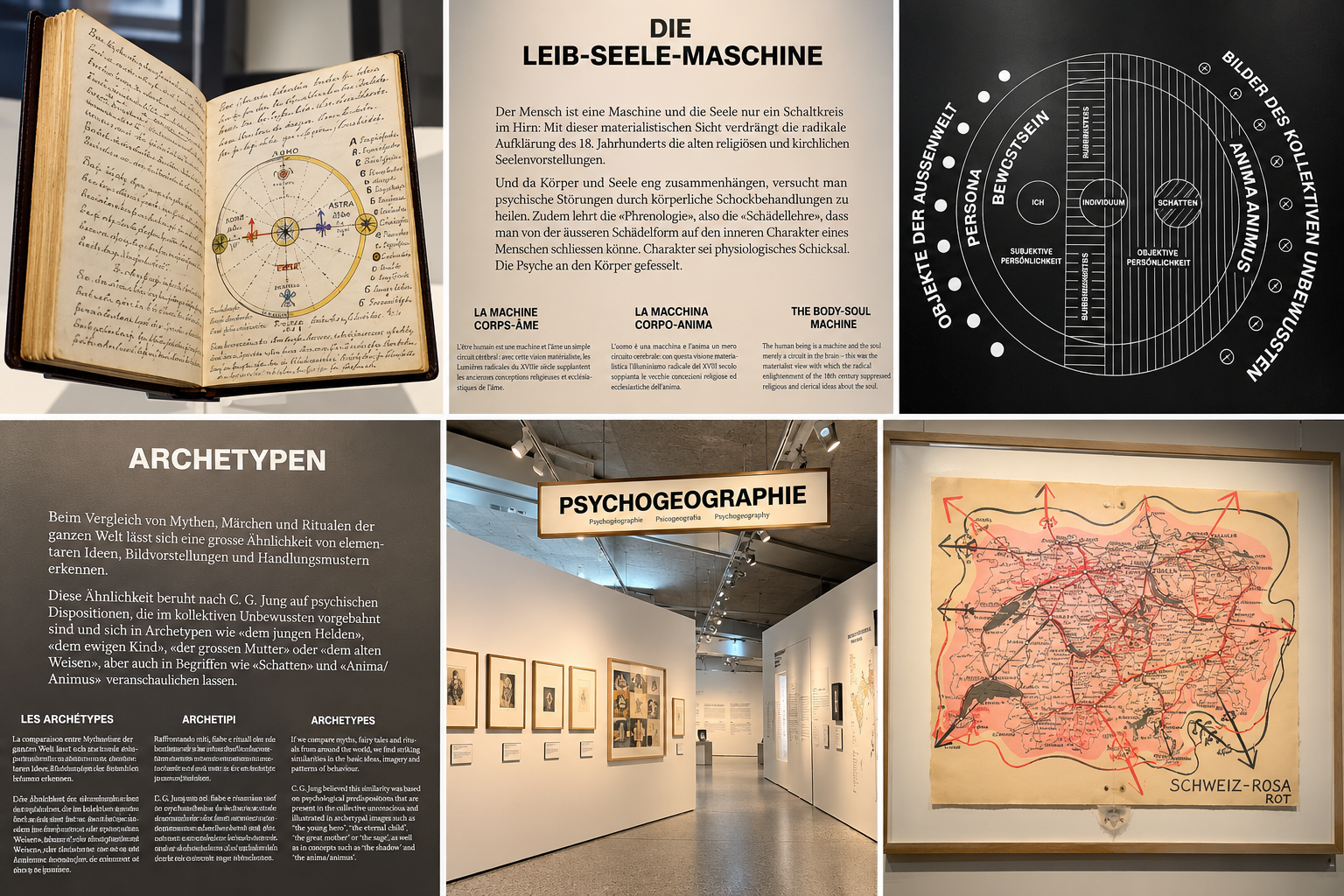
A panel called Die Leib-Seele-Maschine — The Body-Soul Machine — explored the radically materialist view that emerged during the Enlightenment, in which the human being could be understood as a machine and the soul reduced, in essence, to circuitry in the brain. It also showed some of the troubling directions taken by attempts to connect body and psyche, including phrenology and the belief that personality and character could be inferred from the shape of a person's skull.
Looking at those ideas today, it is easy to recognise how wrong some of them were, and yet I found the question underneath them surprisingly contemporary: where does our inner experience actually come from?
For centuries, we have tried to locate, measure, interpret and draw the psyche. Jung's maps would go in a very different direction.
JUNG’S ATTEMPT TO DRAW AN INVISIBLE WORLD
One of my favourite images from the exhibition was the diagram of Jung's model of the psyche. There is something almost architectural about it: Persona, Consciousness, Ego, Shadow, Anima and Animus, the personal unconscious and, surrounding it all, the collective unconscious.
Jung developed what became known as analytical psychology, particularly after his intellectual and personal break with Freud. While Freud had already made the unconscious central to psychoanalysis, Jung proposed that beyond an individual's personal unconscious lay a deeper collective unconscious, expressed through recurring psychological patterns he called archetypes. Among these were figures and patterns such as the Shadow, the Mother, the Child and the Hero.
Jung believed these archetypal patterns could surface across dreams and fantasies, myths and religions, fairy tales and works of art. Whether one accepts the collective unconscious literally is another matter; Jung's theory of archetypes has been enormously influential in psychotherapy, literature, art and cultural analysis, but it has not been established by contemporary experimental psychology as a biological universal.
What interests me more is the question behind it: why do certain human stories keep returning?
The outsider, the hero, the mother, the shadow; leaving home, losing oneself, returning, transforming. Cultures tell extraordinarily different stories, and yet certain patterns can feel strangely familiar, perhaps because stories sometimes allow us to recognise something about ourselves before we have found the language to explain it.
AND THEN THERE WAS THE “RED BOOK”
At the centre of the exhibition was something altogether more intimate: Jung's Red Book.
After his break with Freud, Jung entered an intense period of inner exploration and, beginning around 1913, deliberately engaged with the dreams, fantasies and images arising from his unconscious. Much of this material was first recorded in notebooks that became known as the Black Books, before Jung reworked and transcribed parts of those experiences into the extraordinary illustrated manuscript eventually known as Liber Novus — the Red Book.
Seeing this material in the exhibition changed my perception of it because, suddenly, this wasn't simply a psychologist constructing a theory. It was also a person attempting to observe his own inner world and to give form, through writing and images, to experiences that could not easily be expressed in ordinary language.
Some of the resulting images are intricate, circular and mandala-like. Jung became increasingly interested in mandalas as representations of psychic order and wholeness, and these visual explorations would eventually become important to his later thinking.
There is something I find compelling in the process, independently of whether one agrees with all of Jung's conclusions: before creating a framework, he paid attention. He observed, recorded and returned to the material, gradually attempting to understand what it might mean.
PERHAPS WE ARE ALWAYS MAKING MAPS
That idea stayed with me as I continued through the exhibition, partly because I began to notice how many maps surrounded me: maps of the psyche and maps of Switzerland, maps of cities and circular maps of consciousness, all of them different attempts to locate, organise or represent something that cannot necessarily be contained within neat boundaries. Perhaps that is what fascinated me most.
We seem to have an enormous human need to make the invisible visible, and so we create models and categories, tell stories, invent symbols and draw maps — not necessarily because the map is reality, but because sometimes we need something that helps us orient ourselves inside a reality that is far more complicated. That idea of orientation feels very close to me.
A map doesn't necessarily tell us where we must go; sometimes its most useful function is simply to help us understand where we are.
BUT WHOSE MAP ARE WE USING?
Towards the end of the exhibition, another section complicated the story again: Ethnopsychoanalysis.
In Zurich, Paul Parin, Goldy Parin-Matthèy and Fritz Morgenthaler developed an approach that brought psychoanalytic inquiry into conversation with ethnology. Between the 1950s and early 1970s, they undertook research journeys in West Africa, including work among Dogon and Agni communities, asking, among other things, how social and cultural conditions participate in shaping psychological life.
Their methods, assumptions and historical context deserve critical examination today, but I found the underlying question remarkably relevant:
Can we understand a person without understanding the world in which that person learned to be a person?
Culture doesn't simply surround us; it gives us ideas about success and family, gender and work, independence and belonging, duty and normality. It influences which parts of ourselves are welcomed, rewarded or encouraged and which become easier to hide, and when we move between cultures some of those assumptions suddenly become visible precisely because they are no longer shared by everyone around us.
For me, this was one of the points at which an exhibition about the history of the psyche became unexpectedly contemporary.
THE LANDSCAPES WE INHERIT — AND THE ONES WE CHOOSE
I left Seelenlandschaften thinking less about Jung himself than I had expected and more about maps: the geographical maps we move across, the cultural maps we inherit, the psychological maps we use to understand ourselves, and the private maps we gradually redraw as our lives change.
Maybe identity isn't something completely internal that we carry unchanged from one place to another. Perhaps it is partly a conversation between our inner world and everything we encounter outside it — landscapes and cultures, relationships and expectations, experiences and transitions — with each leaving traces that can become so familiar that we eventually stop seeing them.
Until something changes.
A country, a career, a family, a relationship; or perhaps we simply return somewhere we once called “home” and discover that we — or the place — are no longer quite the same. It is often in those moments of change that something previously invisible becomes easier to see, and suddenly we notice the map we have been following all along.
The questions this exhibition ultimately left me with were not really questions about Jung at all, but questions about ourselves:
What has shaped the way I understand who I am?
and
Which parts of that map still belong to me?